






Connect with a Lima One expert today!
If you’d like to know more about this topic or see how it applies to your project, let’s talk.
What Does Loan to Value (LTV) Mean in Real Estate?
Loan to value (LTV) is a critical financial ratio that lenders use to assess lending risk by comparing the loan amount to a property's appraised value. For real estate investors, understanding LTV meaning is fundamental to evaluating deals, structuring financing, and maximizing returns while managing risk effectively. Whether you're acquiring your first rental property or scaling a multi-property portfolio, the loan to value ratio directly impacts how much leverage you can access and how much capital you'll need at closing.
One of the biggest factors to consider when evaluating if a residential investment property is a suitable candidate for financing is the loan to value ratio, which defines the leverage an investor will have on the property. Both lenders who underwrite properties for financing and borrowers who are evaluating the quality of an investment focus on this key number.
Knowing the loan to value of a property loan helps an investor know how much they can borrow and how much money they will have to put down at closing. It is essential to understand when comparing loan options on properties because it is a quick way for an investor to see how much leverage they will have on the investment.
Here is what investors need to know about LTV loan calculations and options.
How to Calculate LTV
To calculate LTV, an investor needs to divide the loan amount for a property by the appraised value of the property.
LTV Formula: (Loan Amount ÷ Property Value) × 100 = LTV Percentage
If a property is worth $400,000, and an investor is offered $300,000 in a loan on the property, then the loan to value ratio is 75%.
This example shows the importance of understanding LTV. In this scenario, an investor offered leverage of 70% LTV from a lender would only be able to finance $280,000 on the property. An offer of 80% LTV would equal a loan amount of $320,000.
The leverage determines how much the lender will offer on the purchase of a property with the difference between that leverage and the purchase price representing the amount of money the investor will need to put down. Obviously, investors will find it harder to pay $120,000 at closing on a 70% LTV purchase loan than to pay $80,000 at closing on an 80% LTV purchase loan.
Whether you're securing an LTV loan for a single-family rental or a multi-unit property, understanding this calculation helps you compare different real estate loan options and determine which lender offers the best terms for your investment strategy. The math works the same if an investor is refinancing an investment property to get cash out for future purchases.
Cash-Out Refinance LTV Example
A 75% LTV loan on a $400,000 property will lead to a $300,000 loan. If an investor currently owes $260,000 on the property, then this cash-out refinance loan will lead to $40,000 in net proceeds. At 70% LTV, the investor would only get $20,000 in net proceeds. This shows how, in a cash-out refinance DSCR loan, higher leverage means more cash proceeds going to the investor at closing, along with more debt on the property moving forward.
LTV vs. LTC in Real Estate
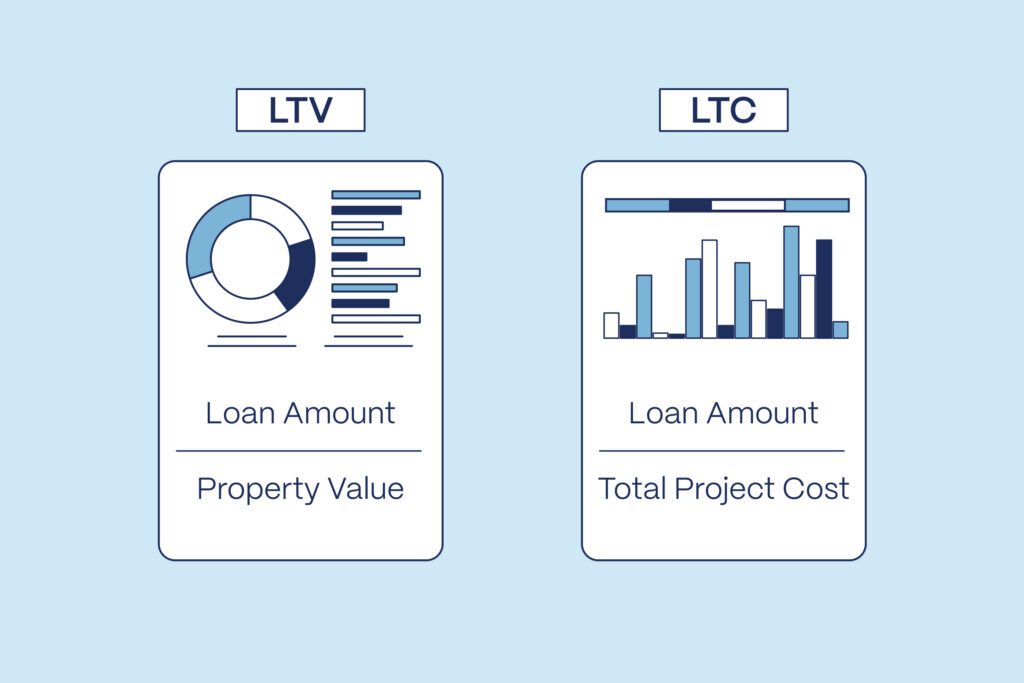
The LTV calculations above typically apply to DSCR rental loans. Fix and flip loans and new construction loans will use LTC, or loan to cost, as well as LTARV, or loan to after-repair value, to calculate leverage. Understanding the difference between these metrics is crucial for investors working across different real estate strategies.
This distinction happens because of the difference in the current-day value of a rental property versus a fix and flip project or new build. For a rental property, the value established by appraisal is an accurate representation of the current-day value of the property. While the purchase price for a rental may be below the value if an investor finds a good deal, the appraisal provides both the investor and the lender some certainty about how much the property could sell for at the current time in the current condition.
What LTV Means for Fix & Flip, Rental, and Construction Loans
For a fix and flip property, the current-day value is much less than what the value will be after the flip is completed, because of the work the investor will do to upgrade the property. This means the current-day value of the property is not the most reliable way to underwrite a loan on the property. Instead, a lender will consider the costs of the property plus the costs of rehab and then lend a percentage of that using a loan to cost ratio.
The lender will also get an appraisal on the after-repair value of the property, which will determine the loan-to-after-repair value (LTARV) ratio. Typically, the LTARV on a fix and flip loan will be up to 70%, which is why many investors use the 70% rule when evaluating flips. A fix and flip property will have to meet a lender’s requirements for both the LTC and LTARV ratios.
New construction loans work much like flip loans, with the only notable difference being that the current costs are the cost of the lot plus the cost of construction. This case study of our Napa Valley new construction development in California explains how LTC and LTARV ratios work on a Lima One new construction loan.
For a rental loan, the calculation is much simpler because it compares the loan amount to the appraised value of the property. A loan only needs to meet this single ratio, not the combination of ratios that a fix and flip or new construction loan does. This works both on property purchases like this Fort Lauderdale fix and flip one, as well as on portfolios like this Chesapeake Bay rental example.
What Is Considered a “Good” Loan to Value Ratio for Investors?
What LTV ratio can investors expect on rental loans from private lenders like Lima One Capital? Industry standard is up to 80% LTV on rental loan purchases and refinances. Typically, if an investor is doing a cash-out refinance DSCR loan, they can get up to 75% LTV leverage.
Lima One’s rental loans offer industry-leading leverages, along with other benefits, including:
- Flexible prepayment penalty options that give you control over your exit strategy
- Multiple loan structures, including 30-year fixed rate loans, loans with 5/1 or 10/1 ARMs, and a 5-year interest-only structure with 25-year amortization
- Standard 90-day seasoning with waived seasoning for refinances from Lima One fix and flip, new construction, or bridge loans
- Streamlined underwriting focused on property performance and investor experience
- Competitive monthly payments that maximize cash flow potential
Loan Spotlight: LTV on Rental Loans
With these basics on what LTV is in view, it is time to focus on how investors can use LTV on several types of DSCR rental loans. Here is a breakdown of LTV for rental property on Lima One rental loans by loan purpose:
- Property purchases: Maximize your purchasing power with up to 80% LTV on rental property acquisitions. The purchase loan on this luxury home in Florida is a good example of how Lima One structures high-leverage deals for qualified investors.
- Rate/term refinances: Up to 80% loan to value, as long as the investor is getting 3% cash out or less. Investors can get this LTV on properties they are refinancing out of ARMs or for better interest rates. This loan term flexibility allows you to optimize your portfolio's cost of capital without reducing your equity position.
- Cash-out refinances: Assess equity in your portfolio with up to 75% LTV on cash-out refinances, both on single properties and on portfolios like this Virginia example. This is perfect for investors looking to extract equity to fund additional home equity loan-style purchases or property improvements.
Important Note: Max LTV leverage is available to borrowers with the best credit. Other factors, including property location, DSCR ratio, and deal size, will also impact the LTV ratio an investor can receive.
Why LTV Matters for Rental Investors
LTV determines how much money an investor must put down to purchase a property, and how much money an investor can receive at closing for a refinance of a property with equity. While investors may seek maximum leverage at the highest LTV ratio to maximize cash on hand, they should be aware that using all equity in a property to maximize LTV increases the risk on the property.
LTV limits protect an investor against stagnating home prices or market shifts that could impact potential sale prices of properties in the future. High LTV ratios like those Lima One offers on rental loans allow investors to successfully scale their portfolios by purchasing more properties while also leaving enough equity in properties to safeguard the investment. This approach balances aggressive growth with intelligent risk management, a hallmark of successful long-term real estate investing.
From conventional loans to specialized fix and flip financing, LTV meaning remains consistent across all real estate loan types, though how it's applied varies by loan product and lender requirements.
Staying LTV-Savvy While Maximizing Returns
One more thing for investors to consider: Choosing lower LTV ratios on DSCR loans can lead to better interest rates. When an investor keeps more equity in a property, a loan is inherently less risky, which means lenders can be more aggressive in pricing the loan. This leads to better cash flow over the life of the loan through reduced monthly payments.
Investors should balance their needs for cash at closing versus the recurring income they will receive from their investment property, based on their investment strategies. A property loan with 70% LTV may have higher upfront costs but lower monthly debt service, while an 80% LTV property loan maximizes leverage but increases the loan term obligations. Your optimal LTV depends on your portfolio strategy, credit scores, available capital, and growth objectives.
Lima One’s team of loan consultants is ready to discuss your strategy. We'll use Lima One’s premier suite of rental loan options to right-size the LTV, down payment, and monthly cost for a DSCR loan that aligns with your investment goals. Talk to a Lima One expert now about the best leverage for your next rental property purchase or refinance.
Frequently Asked Questions About LTV in Real Estate
What does LTV mean in real estate?
LTV (loan to value) means the ratio between the loan amount and the property's appraised value, expressed as a percentage. It's calculated by dividing the loan amount by the property value and multiplying by 100. This metric helps lenders assess risk and helps investors understand their leverage position.
How do you calculate LTV on a rental property?
Divide the loan amount by the property's appraised value, then multiply by 100 to get the percentage. For example: $300,000 loan ÷ $400,000 value = 0.75 × 100 = 75% LTV. This calculation determines both your required down payment and the equity you'll maintain in the property.
What is a good LTV ratio for investment property?
For rental properties, 75-80% LTV is considered good, balancing leverage with equity protection. Lima One Capital offers up to 80% LTV on rental property purchases and rate/term refinances, and up to 75% LTV on cash-out refinances among the most competitive terms in the private lending industry.
What's the difference between LTV and LTC?
LTV (loan to value) compares the loan to the current property value and is used for rental property loans. LTC (loan to cost) compares the loan to total project costs, including purchase price and construction costs, and is used for fix and flip loans and new construction loans. Both ratios serve to quantify leverage but apply to different investment strategies.
Does LTV affect my interest rate?
Yes, LTV directly impacts your interest rate. Lower LTV ratios (more equity in the property) typically qualify for better interest rates because they represent lower risk to lenders. Investors should evaluate whether maximizing leverage or minimizing monthly payments better serves their investment strategy.
Can I get an LTV loan above 80% for investment properties?
Most private lenders, including Lima One Capital, cap investment property loans at 80% LTV to maintain appropriate risk levels. While some government-backed programs like VA loans offer higher LTV for primary residences, investment properties typically require more substantial equity positions. Bridge loans and home equity loan products may have different LTV requirements.
Ready to maximize your LTV on your next investment? Talk to a Lima One loan consultant about rental loans with up to 80% loan to value—get your custom quote today and discover why thousands of real estate investors trust Lima One Capital for their financing needs.
Subscribe for More Insights
Get the latest industry news & Lima One updates.